
How to Photograph the Aurora Borealis (Northern Lights)
Disco in Heaven
Witnessing the majesty of the Aurora Borealis (Northern Lights in layman's terms) had mostly been an experience reserved for passengers aboard Norwegian Coast cruise liners.
Alas, on 10th May 2024, at just past 22:30, I hurried along a West Cumbrian lane away from residential light pollution to marvel at this very spectacle.
According to a BBC News article by Eve Watson on 1st February 2026, 'BBC South West senior broadcast meteorologist, David Braine, said the years 2025 and 2026 are "believed to be the peak for 'solar cycle 25'".'
Exciting news in astrophotography!
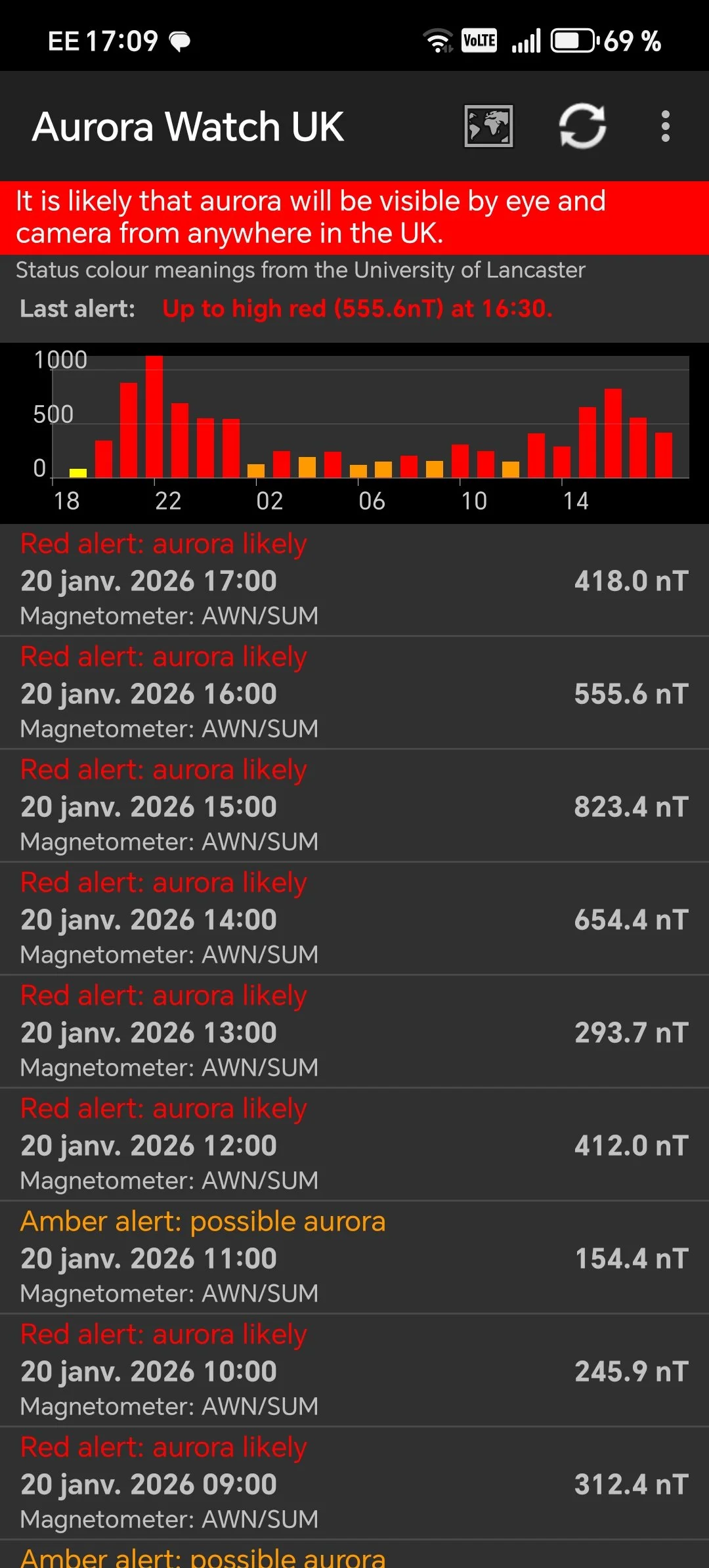
My Aurora Watch UK app incessantly pinged for most of the evening with alert notifications
Fast-forward to 20th January 2026…how lucky was I to have seen it for the second time in as many years?! A glow so bright that seabirds swarmed the skies singing songs of sunrise…at 10 p.m!
This would be the perfect test drive for my recently purchased Nikon D500. And what do I have to show for it? A photograph that features as the leading image for an online BBC News article on the subject of this meteorological phenomenon. I’m chuffed to bits!
You can access the article HERE.
I encourage all photographers to share their shots. Acknowledgement, praise and recognition gives confidence that others see value in our work. For me, this affirms why I do what I do.
- Matthew Shaw
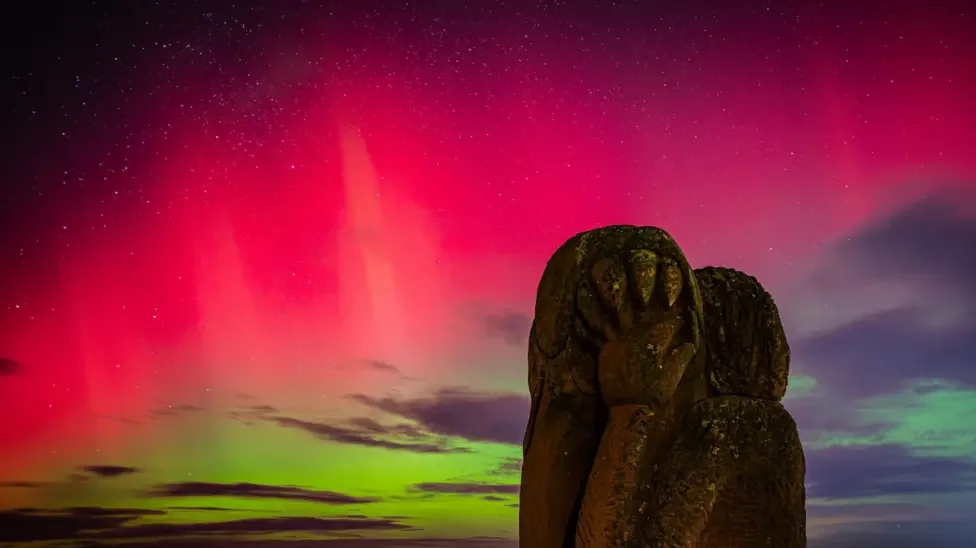
The Harrington shoreline in Workington was illuminated in pink
Thinking about giving it a go?
Here’s the method:
- Use a fast lens (one with a wide maximum aperture, i.e. f/2.8)
Note: Full-frame cameras allow more light to reach the sensor. If you have crop sensor (like me), fear not! It'll get the job done!
- Disable autofocus, we're going manual for this…
- Switch to "Live View" and zoom in using the corresponding button on the back of the camera to visualise the brightest star in the sky
- Adjust the focus ring until that star appears sharp (small and pinpoint)
- Zoom out and switch away from "Live View" (back to the optical viewfinder for DSLR cameras)
- Turn down “Monitor Brightness” in "Settings" to prevent stray light entering the camera through the viewfinder
Note: If like my Nikon D500, your camera body has a switch to open/close the shade in the viewfinder, this too is useful for long exposure photography for the same reason
- Switch the camera to “Manual” mode. Shutter speed: 15 seconds. ISO: 1600. Aperture: widest possible for your lens. It's trial and error. You can always dial up or down later to balance the exposure
Tips:
- Fully charge your battery before heading out
- Fiddle with camera settings before it gets dark (either at home or arrive early on location)
- Pack a head torch, a hot beverage in a thermos flask, and wrap up warm
Ready, steady, shoot!
Since the shutter will be open for an extended period of time, you’ll need to minimise unintentional camera shake to keep it crisp; be sure to lock your camera off on a tripod.
Pressing the shutter button sends shockwaves through the camera resulting in blurry photographs at longer exposures; consider using a shutter release cable (can be picked up quite cheaply for around £15). If you don't have one, use the camera's inbuilt exposure delay timer. This allows the camera to steady and settle before capturing light.
Don't overlook composition!
Sure, turn your lens towards the sky. But without that foreground interest, that sense of place, the resulting image may as well be a desktop screensaver. Find something nearby (preferably recognisable and of local interest) to ground it.
Go away, far away!
Dark sky zones are best for any type of astrophotography as you’ll want to avoid artificial light sources. I satisfied myself with a coastal location. That said, I had to move quick! It didn't take long for a stream of cars to descend on the scene. It baffles me why anyone would show up to watch the Northern Lights only to sit drowning it out with ultra-bright LED car headlights?! In actual fact, their dazzling beams ended up being much appreciated in accentuating the scene. You will see (via the link above) that the harbour wall is illuminated. This technique, when deliberately employed, is known as "light painting" and can help draw the eye towards a focal point. In this example, it created interest in the lower half of the frame and added depth.
Download the Aurora Watch UK app today and snap your own shots. You be amazed how easy it is!
Fun fact:
In the near darkness, I believed the statue to be a loving couple romantically gazing into the bright lights over the sea.
The broad light of day revealed a sobering reality: it’s actually a man getting his hand bitten off by the fish slung over his left shoulder. Cast a Light on that!